
'Happily,' says Ambassador B S Prakash, 'BRICS displayed new-found energy and built something real, a bank. Between needless nihilism and as yet unjustified euphoria, there are many stations for the BRICS train and we can watch its progress with renewed interest.'

Why is Xi Jinping visiting Saudi Arabia, Egypt and China this week? Former RA&W officer Jayadeva Ranade explains the significance of China's outreach to the Middle East.
Aam Aadmi Party chief spokesperson Yogendra Yadav tells Somesh Jha how Delhi has moved beyond Shahi Imam-type politics. Yadav also takes a dig at Finance Minister Arun Jaitley, and says the AAP had formulated its policies on the streets, unlike the Bharatiya Janata Party.

Oil Minister M Veerappa Moily has suggested pricking the ballooning oil bill with everything from a street theatre campaign encouraging lower fuel use, to shutting fuel stations, to increasing imports from Iran.

The prime minister made the reference about the functioning of the Parliament against the backdrop of the virtual washout of its Monsoon session over various issues.
Report card of the Narendra Modi-led central government for the first six months, on the basis of ratings by top CEOs, under key parameters.

'The biggest lacuna in this agreement is it is called 'full civil nuclear cooperation agreement.' Actually, it is anything but full.'

'It is in the interest of both sides that the visit of the US President is seen as being successful. Both sides have invested considerable political capital in it. This rapid exchange of visits and the decisions taken have to be justified, beyond the symbolism, which is no doubt important in itself. This opportunity to impart a fresh momentum to ties should not be missed,' says former foreign secretary Kanwal Sibal.
Dual methodology for e-auction to introduce price ceiling for power sector

Global management recognised India's potential.

Contrary to the bragging that marked its two-year anniversary, the government's timidity on reform is simply astounding.

Modi, who is undertaking his first visit to China as prime minister, will reach the ancient city of Xi'an, the home town of President Xi Jinping, for a summit meeting, an unusual departure from normal protocol and seen as a reciprocal gesture by the Chinese leader who was hosted by Modi in Ahmedabad when he visited India in September last year.
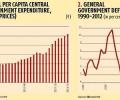
One may fault this government for incompetence, corruption, and delayed action but it cannot be faulted for lacking a vision.

There's still little indication of forward movement in Indo-US defence relations.
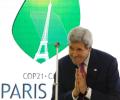
If Paris really meant to serve as a landmark in recognising equity in climate negotiations, it should have heralded the second phase of the Kyoto protocol. Instead we have all countries, India and China included, all signing up with voluntary commitments in what can only be seen as a race to the bottom, reports Darryl D'Monte.

Bajaj three-wheelers outsell Chinese three-wheelers in Peru. The Pulsar is number one in its category. Nikhil Lakshman discovers in Lima that even though the Chinese are far ahead in investments in Latin America's fastest growing economy, Indian manufacturing and IT are holding its own.

The Economic Survey was tabled in the Parliament on Friday.
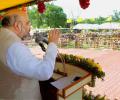
'The BJP should know that simple caste arithmetic may have ceased to follow the basic law of addition.' 'Adding up seemingly distinct vote banks can even cause overall reduction in numbers,' says Sudhir Bisht.
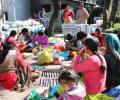
Sanjeev Nayar offers some ideas on how Indians can help in improving the lives of those living in border areas and in the process help the Indian Army.
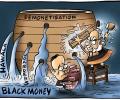
'Modi is likely to make more announcements to win or retain popularity, and put himself at the centre of things even more than now,' says T N Ninan.

Japan has the capital and needs to pull out of China, which has been its major destination. India, on the other hand, desperately needs capital especially for infrastructure, argues Rajeev Srinivasan.

The government has provided a long-term vision.

President Pranab Mukherjee on Monday addressed the first joint sitting of Parliament as mandatorily required under the Constitution after the general elections. The address is the political, economic and foreign policy road map of the Narendra Modi government and covers virtually all crucial areas.

BS Annual Awards 2014: Power-packed jury picks the best 7 of corporate India

India'sstartups have a good beginning but will they survive competition is a big questions which needs immediate attention.

I-T lens on current account deposits over Rs 12.5 lakh. All the news and more post demonetisation.

A special episode of the Prime Minister's radio broadcast Mann ki Baat featuring US President Barack Obama and Prime Minister Narendra Modi was aired on Tuesday night. The 35-minute special broadcast of 'Mann Ki Baat', which marked the rapport between Modi and Obama, touched on issues ranging from public health and personal inspirations of the two leaders, both of whom have come up from simple beginnings to assume to top positions of the respective countries. What follows is a transcript of the Mann ki Baat episode.

Read the full transcript of President Obama's State of the Union address on Wednesday at the US Capitol in Washington.

Indian economy about to take-off
 © 2026 Rediff.com - Advertise with us - Disclaimer - Privacy Policy - Sitemap - Feedback - About us - Terms of use - Grievances